
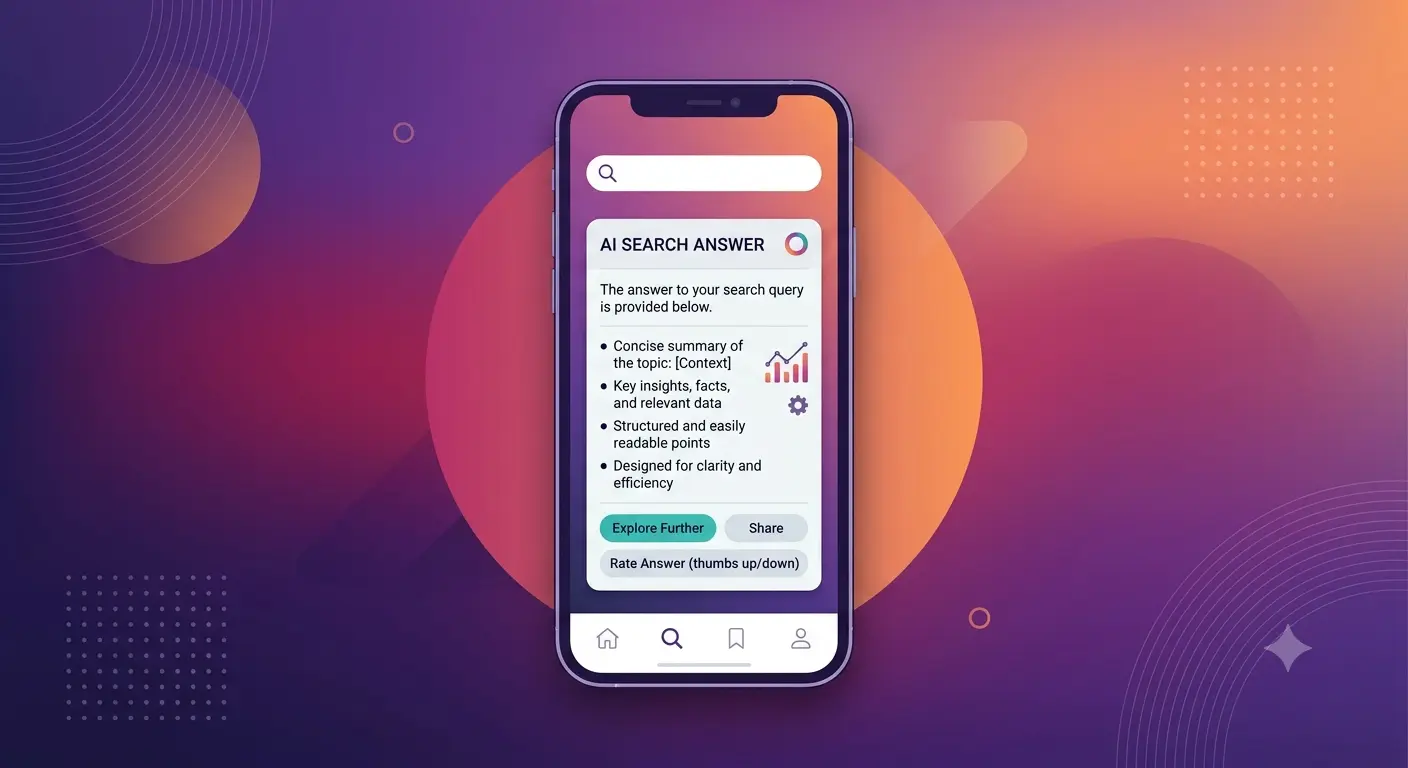
Type a question into Google today and there’s a good chance you’ll get your answer before clicking a single website. AI Overviews sit at the top of the results page. ChatGPT, Gemini and Perplexity are quietly becoming search engines in their own right. And a growing share of Indian users — especially outside the big metros — are simply asking a voice assistant instead of typing at all.
This is arguably the biggest shift in how people in India find information, products and brands since mobile overtook desktop. It has a name: Answer Engine Optimization, or AEO. If your SEO strategy still revolves around ranking #1 on a page nobody scrolls through in full anymore, it’s worth understanding what’s changed — and what to do about it.
What Is Answer Engine Optimization (AEO)?
Traditional SEO was built around a simple goal: rank a page as high as possible for a keyword, and let the click-through do the rest. Answer Engine Optimization starts from a different question — will an AI system trust my content enough to use it as the answer?
AEO, sometimes called Generative Engine Optimization (GEO), is the practice of structuring content so AI-driven search tools — Google’s AI Overviews, ChatGPT, Gemini, Perplexity, and voice assistants — can understand it, extract it accurately, and cite it as a source.
The destination hasn’t changed: you still want to be found. What’s changed is the audience. You’re no longer writing only for a person scanning search results — you’re also writing for an AI model deciding whether your page deserves to be quoted.
Why This Matters More for Indian Brands Right Now
Three shifts make this especially relevant in India:
Mobile-first, voice-first behaviour
A large and fast-growing share of Indian internet users now rely on voice search, particularly outside the metros. Voice queries almost always return a single spoken answer, not a page of links — so there’s no “second result” to fall back on.
AI Overviews are rolling out at scale
Google’s AI-generated summaries now appear for a meaningful share of informational searches in India, often pushing traditional organic results further down the page — sometimes below the fold entirely.
The next wave of users is vernacular-first
A large majority of India’s growing internet base consumes content primarily in regional languages, and AI answer engines are getting noticeably better at understanding and summarising that content — which is reshaping who gets cited.
How AI Search Engines Actually Choose an Answer
AI answer engines don’t rank pages the way traditional search does — they extract and synthesise. That means the content that gets chosen tends to share a few traits:
- It answers the question directly, early. Bury the actual answer under three paragraphs of preamble and an AI system has to work to find it — and will often pick a competitor’s page that didn’t make it work.
- It’s structured, not just written. Clear headings, short paragraphs, bullet points and tables are easier for an AI system to parse and extract than a wall of unbroken text.
- It uses schema markup. FAQ schema, HowTo schema and Article schema give AI systems explicit, machine-readable signals about what your content is and does.
- It demonstrates E-E-A-T — Experience, Expertise, Authoritativeness and Trustworthiness. Google’s long-standing quality framework matters even more when an AI system is deciding whose claim to trust.
- It stays current. AI systems tend to favour recently updated content on topics where facts change, which means a page sitting untouched since 2021 is quietly losing ground.
A Practical AEO Checklist for Indian Businesses
Start here
- Answer the core question in the first 2–3 sentences of the page, then expand.
- Add FAQ sections with the real questions your customers ask, marked up with FAQ schema.
- Use descriptive, specific H2/H3 headings — phrase them as questions where it fits naturally.
- Keep one idea per paragraph; aim for 2–4 sentences, not ten.
- Add comparison tables wherever you’re contrasting two options — AI systems extract these cleanly.
- Refresh your highest-traffic pages at least twice a year, and update the visible “last updated” date.
- Build topical authority with a cluster of connected articles, not a single standalone post.
- For Tier 2/3 or regional-language audiences, create properly localised versions of key pages — not machine-translated copies.
Common AEO Mistakes to Avoid
- Writing for keywords instead of questions. AI systems respond to how real people ask things, not strings of keywords stitched together.
- Ignoring schema markup entirely. It’s one of the few genuinely free, high-leverage signals still available to you.
- Treating AEO as a one-time project. AI answer engines re-evaluate sources continuously; a page optimised once and never revisited will slide.
- Publishing thin, generic content built purely for volume. AI systems are increasingly good at spotting and skipping shallow content, however well the keywords are placed.
AEO vs Traditional SEO: A Quick Comparison
| Dimension | Traditional SEO | Answer Engine Optimization |
|---|---|---|
| Goal | Rank in the top 10 results | Get cited as the answer |
| Primary reader | A person scanning links | An AI model extracting facts |
| Content shape | Long-form, keyword-dense | Structured, direct, scannable |
| Success signal | Click-through rate | Citation / inclusion in AI answer |
| Key lever | Backlinks, keyword density | Schema markup, clear structure, E-E-A-T |
Where This Leaves Indian Brands
None of this means traditional SEO is dead — ranking well still drives a meaningful share of traffic, and likely will for years. But treating AI answer engines as an afterthought is no longer an option for any brand that depends on being found online.
The brands adapting early — structuring content around real questions, investing in schema, and keeping their best pages genuinely current — are quietly picking up the visibility that slower-moving competitors are losing.
Frequently Asked Questions
Is Answer Engine Optimization the same as SEO?
Not quite. AEO builds on SEO fundamentals but optimises specifically for how AI systems extract and cite content, rather than purely for ranking position on a results page.
Do I need to abandon traditional SEO for AEO?
No. Most AEO practices — clear structure, schema markup, strong content — also improve traditional SEO. Think of AEO as an extension of SEO, not a replacement for it.
How long does it take to see results from AEO?
Similar to SEO, expect anywhere from a few weeks to a few months, depending on your site’s existing authority and how competitive the topic is.
Does AEO work for regional-language content in India?
Yes, and it’s becoming increasingly important, since a large and growing share of India’s internet users search primarily in regional languages.
What’s the single highest-impact AEO change I can make today?
Add well-written FAQ sections with proper schema markup to your most important pages — it’s one of the fastest ways to start showing up in AI-generated answers.
Want your content built for how people search in 2026?
Our SEO team structures, schemas and refreshes your content so it’s ready to be found — by people and by AI.
Book a Free Strategy Call